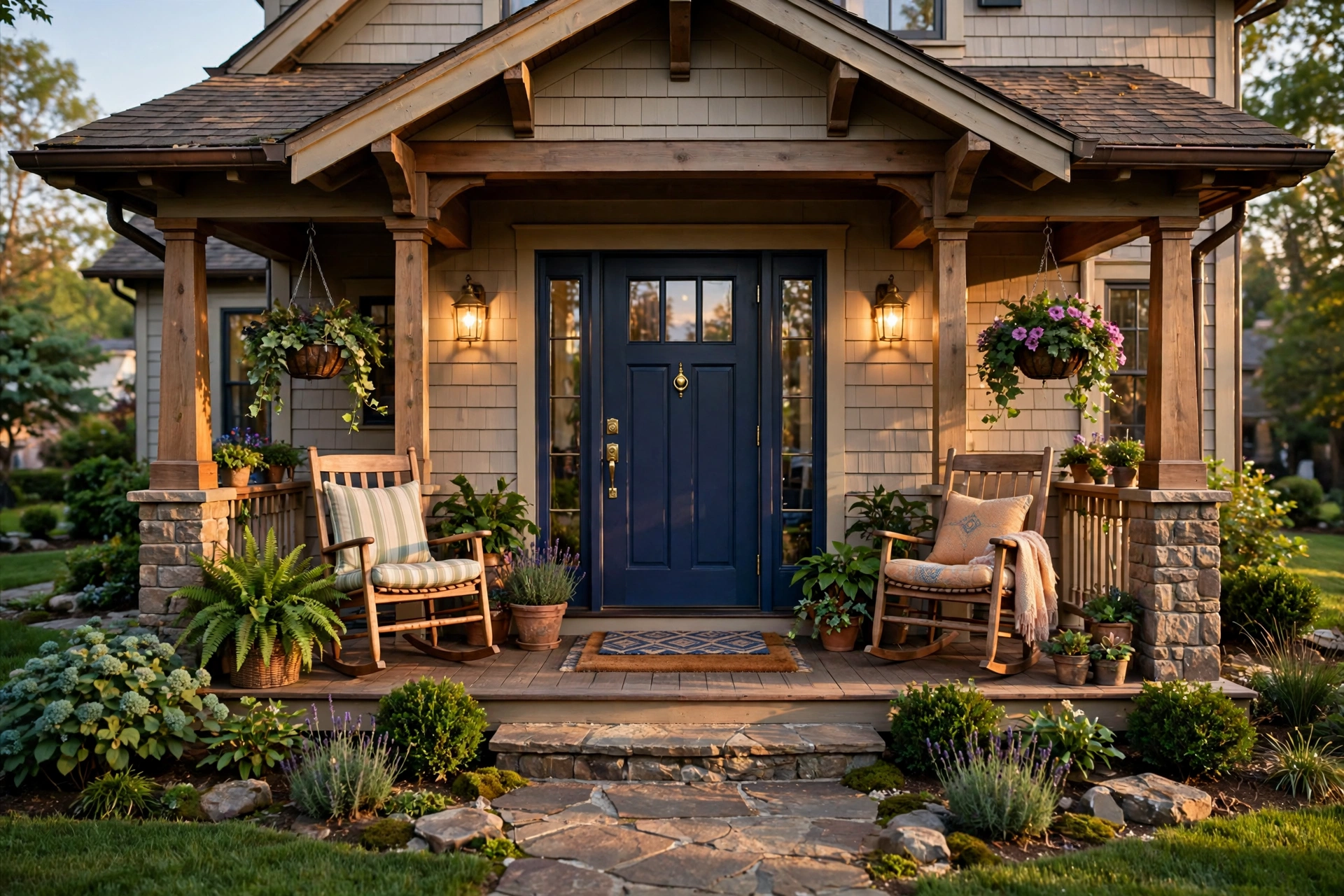
Your front porch is the first thing anyone sees when they arrive at your home, and it sets the tone for everything behind the door. Buyers form an opinion within seconds of pulling into the driveway. Yet the porch is one of the most overlooked parts of a house: a faded doormat, a dead plant, and a light bulb that burned out months ago.
That is a missed opportunity. Porch upgrades are among the cheapest ways to improve curb appeal, and they work fast. A fresh coat of paint on the front door, proper lighting, and a place to sit can change how a whole house reads from the street. This guide covers the ideas that make the biggest difference, with realistic costs.
Why the porch matters more than you think
Real estate agents consistently rank curb appeal near the top of what sells a home, and the porch is the centerpiece of that first impression. It signals care, comfort, and pride of ownership in a way that a lawn alone cannot.
The numbers back it up. A new steel entry door is one of the highest-returning exterior projects in the US, regularly returning 70 to 100 percent of its cost at resale. A full porch refresh, meaning paint, lighting, hardware, and planting, typically costs between $500 and $3,000, a fraction of a kitchen or bathroom remodel. In warm states like Texas and Florida, a good porch gets used most of the year.
Start with the front door
If you do only one thing, paint or replace the front door. It is the focal point of the entire facade.
A quality exterior paint job on a door costs $75 to $200 in materials if you do it yourself, or $200 to $500 professionally, and it takes a weekend at most. Choose a color with confidence. Deep navy, forest green, classic black, and warm red all work on most house styles, and a bold door color photographs beautifully. Test a sample in daylight before committing, since a color can look very different in full sun.
If the door itself is damaged, warped, or badly dated, replacement is worth it. A new fiberglass entry door costs $1,000 to $3,000 installed, and a steel door runs $800 to $2,500. While you are at it, upgrade the hardware. A solid handleset in matte black or brushed brass costs $80 to $250 and instantly makes an old door feel new. Match the finish to your light fixtures and house numbers so the entry looks intentional.
Pick a porch style that matches your house
The best porches look like they belong to the house. A farmhouse porch with chunky square columns looks wrong on a mid-century ranch, and a sleek metal-and-glass entry looks wrong on a Victorian. Before buying anything, identify your home’s style and let it guide your choices.
A craftsman porch uses tapered wood columns on stone or brick piers and warm wood tones. A farmhouse porch favors white railings, beadboard ceilings, rocking chairs, and simple black lanterns. A colonial porch is more formal, with symmetrical columns and restrained plantings in matching planters. A modern porch uses clean lines, cable railings, and minimal furniture in neutral tones. A cottage porch is informal, with climbing plants, a swing, and mixed textures.
If you are unsure which direction fits, a 3D rendering of your existing facade with a few porch options is a cheap way to test ideas before spending on materials.
Seating that invites people to stay
A porch without seating is just a walkway with a roof. Even a small porch can hold one good chair.
For a porch at least 6 feet deep, a pair of rocking chairs or a small bench works well. Leave 3 feet of clear walkway from the steps to the door so nobody has to squeeze past furniture. For deeper porches, 8 feet or more, a porch swing is the classic choice. A standard swing is 4 to 5 feet wide and needs about 2 feet of clearance on each side plus 3 feet behind it. Hang it from ceiling joists with proper hardware, never from a thin ceiling board. Budget $200 to $600 for a quality swing plus $100 to $200 for installation if you hire it out.
Cushions and an outdoor rug finish the seating area. Choose outdoor-rated fabrics that resist fading and mildew, and pick a rug at least as wide as your seating arrangement. Budget $50 to $150 for a good outdoor rug and $30 to $80 per cushion.
Lighting: the cheapest big upgrade
Porch lighting is the highest-impact, lowest-cost upgrade on this list. Good lighting makes the house look welcoming at dusk and improves safety on the steps.
Choose wall lanterns that are one-quarter to one-third the height of the door. A standard 80-inch door calls for a lantern 20 to 27 inches tall.
Layer the light. Add a ceiling light or recessed lights under the porch roof, and consider a small spotlight aimed at a tree or architectural feature for depth. Warm light, around 2700K, flatters wood, brick, and skin tones far better than harsh cool white. Put the porch light on a dusk-to-dawn sensor or a smart switch, and add solar path lights along the walkway for $30 to $80 a set.
Plants, planters, and seasonal color
Plants are the fastest way to make a porch feel alive, and they hide a surprising number of flaws. A pair of matching planters flanking the door creates symmetry and draws the eye to the entry. Use planters at least 16 to 20 inches tall so they read from the street.
Match plants to your climate and sun exposure. In hot southern states, heat-tolerant choices like lantana, hibiscus, and ornamental grasses hold up through summer, while shade-loving ferns and hostas suit north-facing porches. Hanging baskets add color at eye level and work well on porches with limited floor space.
Keep it maintained. Dead plants are worse than no plants, because they signal neglect. If you travel often or forget to water, choose drought-tolerant plants or add a simple drip line.
Flooring, ceiling, and the details buyers notice
Once the big pieces are in place, the surfaces underfoot and overhead decide whether the porch feels finished.
Concrete porch floors can be painted with porch and floor enamel for $50 to $150 in materials, and a fresh coat in a soft gray or warm charcoal transforms a stained slab. Wood decking can be restained for a similar cost.
The porch ceiling is often forgotten, and it is one of the first things visitors see when they look up. The classic Southern choice is a soft blue, often called haint blue, which looks fresh and keeps the space feeling airy. A coat of exterior ceiling paint costs $40 to $100 and takes an afternoon.
Finally, the small details: house numbers, the mailbox, and the doormat. House numbers should be at least 4 inches tall and easy to read from the street. A layered doormat, a coir mat over a larger outdoor rug, costs $30 to $60. A clean, matching mailbox, $40 to $120, completes the entry.
How much do porch upgrades actually cost?
Here are typical ranges for US projects in 2026:
- Front door repaint, DIY: $75 to $200; professional: $200 to $500
- New fiberglass entry door, installed: $1,000 to $3,000
- Door hardware upgrade: $80 to $250
- Pair of wall lanterns: $160 to $600
- Porch swing with installation: $300 to $800
- Rocking chairs, pair: $150 to $500
- Outdoor rug and cushions: $80 to $230
- Planters and plants: $100 to $400
- Porch floor paint or stain, DIY: $50 to $150
- Ceiling repaint: $40 to $100
- House numbers, mailbox, doormat: $110 to $290
A cosmetic refresh, meaning paint, lighting, hardware, plants, and soft furnishings, lands between $500 and $2,000. A mid-range upgrade that adds a new door and a swing lands between $2,000 and $5,000. A full rebuild with new decking, columns, and railings starts around $5,000 and can reach $15,000 or more for a large porch. Start with the cosmetic refresh, live with it for a season, and then decide whether the bigger spend is worth it. For a full exterior plan, our exterior design and landscaping service covers the whole front of the house, and you can see typical project pricing on our pricing page.
Frequently asked questions
How much does it cost to redo a front porch?
A cosmetic refresh costs $500 to $2,000, covering paint, lighting, hardware, plants, and furnishings. Replacing the door and adding a swing brings the total to $2,000 to $5,000. A structural rebuild starts around $5,000 and can exceed $15,000 for a large porch.
What is the best color for a front door?
Deep navy, forest green, classic black, and warm red suit most house styles and photograph well. The right choice depends on your siding and brick color, so test a sample in daylight before painting.
How big should porch light fixtures be?
Choose wall lanterns that are one-quarter to one-third the height of your front door. For a standard 80-inch door, that means fixtures 20 to 27 inches tall. Fixtures that are too small are the most common porch lighting mistake.
Can a small porch still look good?
Yes. Even a porch 4 to 5 feet deep can hold a single chair, a wall lantern, a doormat, and a planter. Focus on the door, the lighting, and one or two quality pieces rather than crowding the space.
Do porch upgrades increase home value?
They improve first impressions and photos, which helps a home sell faster, and a new entry door returns 70 to 100 percent of its cost at resale in most cost-versus-value surveys. A porch refresh alone will not add as much value as a kitchen remodel, but it is far cheaper.
Make your porch the best part of the street
A great front porch does not require a big budget or a major renovation. It needs a door worth looking at, light that flatters the house, a place to sit, and plants that are actually alive.
If you want the whole front of the house designed as one plan, porch, walkway, plantings, and all, take a look at our exterior design and landscaping service or get in touch for a free consultation.